



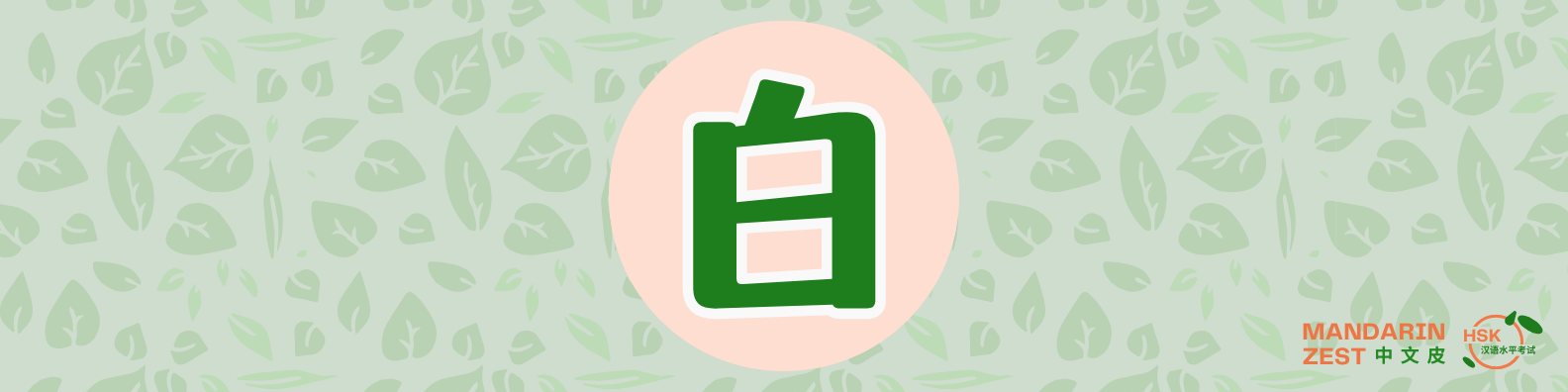
While 白 (bái) usually means "white," in grammar it has a special meaning: doing something in vain or with no effect.
🍃 Basic form with 白
Usually with mono-syllabic verbs like 做, 学, 跑.
Structure:
白 + Verb + 了
Examples: 白做了 – "did it in vain."
🍃 Form with 白白
Usually with disyllabic verbs like 帮助, 准备, 学习.
Stronger emphasis on wasted effort.
Structure:
白白 + Verb + 了
Examples: 白白帮助了他 – "helped him in vain."
🍃 白 as "for free"
Some mono-syllabic verbs combine with 白 to mean doing something for free, often related to senses or consumption.
Examples: 白吃了 – "ate for free."
In short, 白 / 白白 are useful for expressing wasted effort or doing something without result, adding nuance beyond the literal "white."
Sample Sentences
他今天白跑了,商店关门了。He ran there today in vain; the store was closed.
她白白准备了晚会,没人来。She prepared the party in vain; no one showed up.
他喜欢白喝咖啡,看到别人买就跟着要。He likes to drink coffee for free; whenever others buy some, he asks too.
In a Text
小明昨天去图书馆白跑了,因为他想借的书被别人借走了。回到家,他决定自己写作业,但写了半天也白做了,忘记带参考资料。
后来,他想帮朋友复习考试,结果白白帮助了他,朋友一点也不认真。小明只好自己复习,但也很幸运,早饭的时候还能白吃了一碗粥,顺便喝了杯咖啡。
虽然一天都比较忙乱,但小明觉得至少还有一些小幸运。
参考资料 (cānkǎo zīliào): reference materials
粥 (zhōu): porridge
忙乱 (mángluàn): busy; chaotic
Yesterday, Xiaoming went to the library but went there in vain, because the book he wanted to borrow had already been taken by someone else. When he got home, he decided to do his homework, but after working for a while, it was all in vain, since he had forgotten to bring his reference materials.
Later, he tried to help a friend study for an exam, but he helped him in vain—his friend didn’t take it seriously at all. Xiaoming had to study by himself, but at least he was lucky enough to eat a bowl of porridge for free at breakfast, and he also had a cup of coffee.
Although the day was mostly chaotic, Xiaoming felt that at least there were some small moments of luck.

Are you serious about learning Chinese? We also offer structured classes with professional native teachers to help you progress faster.